Thursday, April 12, 2007

Things that make you go hmm . . .


the following essay is a reprint of http://www.dlmark.net/educatio.htm

Philosophy of Education

Why Education Reform Never Works

Education reform never works because when people talk about education they think they mean "education," but actually they mean "school." Education and school are not the same thing. It is school reform that never works; education reform never gets tried. The reason school reform never works is that schools are an obsolete institution. The difference between the best schools and the worst schools is very little.* It is time to replace them with something else entirely.

Schools were invented by the Sumerians thousands of years ago, to educate the children of the elite. They have changed practically not at all. The world has changed greatly since then, the needs of children have changed since then, the needs of society have changed since then, but schools have not changed since then.

Why have schools not changed? Because they are unchangeable, except in very minor respects. Every school is the same: a few adults in charge of a large number of children. That determines what schools must necessarily do: protect the children, maintain order, keep track of things. Those three duties are so all-consuming that what is taught and how it is taught are such a minor part of the school day that they don't matter much.

Think of schools as being like an iceberg: one-sixth showing above the waterline, five-sixths hidden below the surface. The one-sixth that shows represents the curriculum and all the things that reformers talk about. The five-sixths that doesn't show is the dominant part. This five-sixths is what schooling really is.

Schools really teach this: Be careful. Stay in line. Obey. Be quiet. Sit still. Tolerate boredom. Let the authorities decide. Let others do the thinking.

So what do we have to do? Quit talking about schools and start talking about education. Not, "How do we change the schools?" but "How shall we educate the people?"

Suppose we had no way set up to educate people. Suppose schools had not been invented. Start from scratch. How shall we educate the people? What technologies shall we use? Where shall we do it? Who should do it? Who should be in control of educating the people?

Those are the questions that need to be answered.

—Donald L. Mark http://www.dlmark.net/

*A few years back, to the amazement of the education establishment, the school in Oregon which spent the least per student scored better on tests than the school which spent the most.

If you are interested in homeschooling or unschooling (also called deschooling), the Web has a great deal of information. (EdNote: Mark has links & other info on his website)

(EdNote: Mark identifies himself as a Philosopher and Critic of Everything, among other things)


. . . hmm

Things that make you go hmm

I was at the crib, sittin' by the fireplace
Drinkin' cocoa on the bear skin rug
The door bell rang. Who could it be?
Thought to myself then started to shrug
Got to the door. Ding Dong. Who is it?
My girl's best friend had payed me a visit.
Sly as can be, tight dress and all
She knew that I was faithful. I really didn't have the gall.
I tried to chilll. She made the move.
Now I know my girlfriend wouldn't approve.
I didn't realize my girl was settin' me up
Yo, my girl didn't trust me. No!
Yeah, but she lost control I wouln't take the bait.
I said chill baby baby chill baby baby wait
My girl bust in, Caught us creating a boom
She said "Girlfriend"?

Things that make you go hmm
Things that make you go hmm, hmm, hmm
Things that make you go hmm

Here's how it started
Just an example of how another brother can trample
Ruin your life, sleep with your wife
Watch your behind
There was a friend of mine named Jay
Would come over late at night and say hey
I watched the fight. I thought is was alright.
'Cause me and Jay were really really tight
So damned close we had the same blood type.
Months went by and my wife got big
We were havin' a child and I got another gig
So I let Jay move into the crib and chill
He had his own room and helped pay the bills
The time had come (for the baby down to the scene)
It looked like Jay and I couldn't believe
Before my eyes in the delivery room.

The things that make you go hmm
Things that make you go hmm
The things that make you go hmm, hmm, hmm
The things that make you go hmm
Things that make you go hmm
The things that make you go hmm.

Robbie Rob - break it down!

Give it to me Give it to me Give it to me Give it to me (x7)
Give it to me Give it to me

Seventeen and I was havin' a ball
Eleventh grade and "Joe" I knew it all
I fell in love for the very first time
With this girl she really blew my mind
Inner sense and whole lotta class
Style that could give you whiplash
We said hello and my heart be stopped
She was the world and I was on top
Time went by, She filled my universe
We made love, She said I was the first
My boy kept tellin' me. Yo, I don't know
I think your girl's been playing tic tac toe
I'll ask my girl I know she only loves me
Wasn't I the one who tool your viginity?
The look on her face read sorrow and gloom
She said "Yeah, Why do you guys always ask that?"

(Chorus)
Things that make you go hmm
It's the things that make you go hmm

(Repeat Chorus)

Hey ladies
Have you ever had a man
Go away for business, come back with a tan
Comes home late at night from work
You cooked him dinner now you feel like a jerk
Sayin' he didn't have time to eat
And he's not even hungry, he wants to be treat
To the bedroom he said his head hurts
You're only makin' love in radical spurts
Mysterious calls and the phone goes click
You say to yourself "I'm gonna hit him with a brick"
Ain't no way he could be cheatin' on me
I wonder who bought him those BVD's
Dressed to a T to hang with the fellas
Over the guys and I'm getting jealous
Comin' home late smellin' like perfume (fume)

(Repeat Chorus x7)

Things that make you go hmm

-- C+C Music Factory

Thursday, April 5, 2007

Greek Archaeologists Unearth Rich Tomb

Greek Archaeologists Unearth Rich Tomb

April 4, 2007

ATHENS, Greece (AP) - Archaeologists on a Greek island have discovered a large Roman-era tomb containing gold jewelry, pottery and bronze offerings, officials said Wednesday. The building, near the village of Fiscardo on Kefalonia, contained five burials including a large vaulted grave and a stone coffin, a Culture Ministry announcement said.

The complex, measuring 26 by 20 feet, had been missed by grave-robbers, the announcement said.

Archaeologists found gold earrings and rings, gold leaves that may have been attached to ceremonial clothing, as well as glass and clay pots, bronze artifacts decorated with masks, a bronze lock and copper coins.

The vaulted grave, a house-shaped structure, had a small stone door that still works perfectly _ turning on stone pivots.

On a nearby plot, archaeologists also located traces of what may have been a small theater with four rows of stone seats, the ministry said.

Previous excavations in the area have uncovered remains of houses, a baths complex and a cemetery, all dating to Roman times _ between 146 B.C. and 330 A.D.

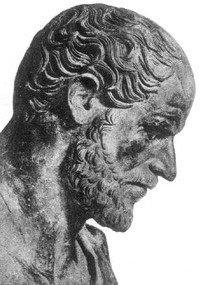
EdNote: Aristotle lived 384-322 B.C.

Tuesday, April 3, 2007

On the Nature of Insanity

On the Nature of Insanity

In conversation today Matt mentioned a man who wrote a 15,145 page story of a fictional world. Henry Darger was an American recluse, who apparently was obsessed with children and insanely enough brutal actions towards them, shown in his collection of newspaper clippings of murdered children. While the man was a bit insane he spent his working life as a janitor and the rest in the recluse of his home. As a child he was admitted to a mental institution for various odd reasons. With the passing of that, he wrote his life’s work entitled The Story of the Vivian Girls, in What is known as the Realms of the Unreal, of the Glandeco-Angelinnian War Storm, Caused by the Child Slave Rebellion. The story is illustrated in watercolor art that Darger painted himself (see above image) and only in his death were his works discovered and brought to light. Just goes to show you, despite a bit of insanity the man had some brilliance in him. Insanity almost brought it out of him, other wise he would of gotten too lazy to write and the work would never have been recorded from his mind. (for more info on Darger google him or ask Mr. Matt)
Some may say that a person who comes in from the world outside our little philosophy group (Is there a world outside?) may see all of Ed's posts and immediately assume he is insane, just like anyone who listens to me talk for more than two minutes. I however wouldn’t be so conceited to assume myself insane. As Thoreau wrote in his essay A Plea for Captain John Brown; “Many, no doubt, are well disposed, but sluggish by constitution and by habit, and they cannot conceive of a man who is actuated by higher motives than they are. Accordingly they pronounce this man insane, for they know that they could never act as he does, as long as they are themselves.” So while people hold a certain disdain for anything considered insane, perhaps the disdain should be towards normal, sane, and mediocre. Because monotony will drive a person insane. Ha ha.
A few people who were known to have mental illnesses, but are revered today for their brilliance: Friedrich Wilhelm Nietzsche, Vincent Willem van Gogh, Ludwig van Beethoven, Leo Tolstoy, John Keats, Ernest Hemingway, Michelangelo, Isaac Newton, Charles Dickens, to name a few. All of these individuals suffered or prospered due to bouts of manic depression, suicidal depression and all other flavors of true insanity. But the real questions comes from a statement made by Ed earlier today about the inhabitants of Mexico City and the Super Volcano under them and why they don’t leave. So I ask you if people don’t like their situation and don’t do anything about it, are they not the insane ones? Or are we all really just vulgar animals? If we know about a situation such as Mexico City and the inhabitants won't do anything are we unjust for not attempting to change these people’s decision to remain in a potential danger?

Wednesday, March 28, 2007

I love playing with fire . . .


That's a quote from Joan Jett and Mae West, just in case you've forgotten.

Now, I have spoken out on this webspace in the hopes of starting a serious discussion -- serious to me means heartfelt and real, not fanciful societal niceties and accepted norms. Are we here to brand Aristotle valid? Or are we here simply to obey Aristotle? Are we equals to Aristotle? Or are we subservient to Aristotle? Are we here to use Aristotle's philosophy in our lives in order to find fulfillment? Or are we here simply to learn what this old, dead guy said?

I posit that better minds than mine have worked on this Aristotle stuff for 2,300+ years . . . and they still haven't fixed it. He's had his run. He had every chance in the book for two millenia, and then some. I think it's time to say: "It's broke. Time for something completely different."

In an attempt to do that I have written a lot of stuff . . . some of it is shit, some of it is divine, and some of it I have no idea if I'm even in the same ballpark as everyone else.

Some of what I put out there I know is wrong -- I was hoping to use them as bait for someone to step up and say: "Hold on a minute there, Ed, this bit is a little off." Even still, these wrong things are valid as discussion points -- because though I know they're wrong, I don't have the answers that are right . . . that's what I hope discussion will reveal for me.

Some of what I put out there was simply to show you how to critique my own words -- give me the same treatment I give Aristotle. Remember, I'm the one who believes in individuality and liberty . . . so I'm the one who believes I must treat others as I want others to treat me. Aristotle is the one who has to be correct or he'll throw a tantrum . . . or run away . . . or do both (look it up). But we don't have to worry about Aristotle . . . he's nothing but dusty bones, if that. He ain't divine.

Some of what I put out there is real. It is these things that Aristotle has no good answer for. Here is where Aristotle is flat-out wrong. Here is where Aristotle's house of cards comes tumbling down.

There is an answer to everything. Aristotle does not have it, but he has some parts of it. In fact, his system is excellent for some things in life . . . like buying a used pickup truck. I used his Virtue-Vice Scale with a friend to help her pick out the best possibilities from hundreds of pickup truck ads. Worked great. But it doesn't work for people -- 2,300+ years have proven that, I don't have to prove it.

Here's something else I don't have to prove . . . that I can post on this site whether or not anyone else does. So . . . it's yours. Have a discussion, and I'll come in when I feel like it -- when you write something I can't resist to comment on.

I'm going on vacation . . . (these pics from the Daughters of Ishtar at a Burning Man Ceremony)

Tuesday, March 27, 2007

Friday, March 23, 2007

Virtuous Men . . .


I read the following piece this morning . . . I have historical stuff emailed to me every morning, it's better than looking at the news . . . I already know what happened yesterday . . . but 2000 years ago? I gotta be reminded . . . I posted this because it hits the nail on the head from where I stand (I love mixing metaphors ). I consider myself closer to Roman . . . um . . . culture . . . for lack of a better word . . . than Greek, and that is why I have some fundamental problems with some Greek ideology . . . anyway, enough of me jibber-jabbering, read someone with an officially awarded and stamped piece of paper that heralds her, N.S. Gill, an expert on this stuff . . .

Virtuous Men of Greece and Rome

H.I. Marrou on the etymology of the Roman virtues

"Instead of wealthy people, almost all the people we know, from Homer to Hercules to Pericles to Euripides and Phidias, were excellent at something, or had received first prize at some kind of contest, including artistic ... theatrical ... or oratorical ... contests, or shone through their politically just ... or militarily ingenious ... examples.
www.ecnet.net/users/big0ama/GreekCulture.html "Greek Cultural History"
H.I. Marrou, in his A History of Education in Antiquity, digresses into the origins of several Latin words:

Latin

Original Meaning

Standard Meaning

laetus well-manured ground joy
felix fertility of the soil happiness
frugi the profits virtue
egregius beast separated from his herd fame
putare prune think

Farming was central to early Roman life and its virtues, hard work, sacrifice, devotion, piety, and frugality, were the virtues of the early Romans. They honored custom which the family was perfectly suited to convey. Besides devotion to the fields and gods, Romans obeyed the father, the pater familias, with mater coming in a close second. Each family was different, each inculcated different values, but all families were also loyal to the state. Although there's an emotional similarity between John F. Kennedy's "ask not what your country can do for you," and Horace's "dulce et decorum est pro patria [literally father-land] mori," in practice we Americans, who show little respect for the institution of family, don't ask "what we can do for our country."

In many ways we have much more in common with the individualist, aristocratic ideal of the Greeks, for whom Achilles' petulant refusal to lead his troops into battle almost cost the Greeks the Trojan War. For the Greeks, individual honor and glory was more important. They prized virtue, arete, beauty and goodness, kalos kai agathos. Aristocracy meant rule by those with greatest merit. [www.ecnet.net/users/big0ama/GreekCulture.html "Greek Cultural History: On Aristocracy" and www.fas.harvard.edu/~gmoritz/papers/s2.html "Virtue and the Proper Political Individual in Antiquity" 11/03/98]

. . . OK, now for something a little different but the same . . . here's a Roman quote on virtue that I think highlights the viciousness fundamental in all the Aristotlian virtues . . . hey, just as I'm an American with some Roman values, this Roman has some Greek values . . . and he elucidates a thoroughly Greek value here, and he backs me up when I say Aristotle's virtuous mean is still fundamentally vicious:

Licet ipse vitium sit ambitio, frequenter tamen causa virtutum est.
Ambition may be a fault in itself, but it is often the source of virtue.
Quintilian, Institutio Oratoria, I, 2, 22

Wednesday, March 21, 2007

Ostara


The first day of Spring is my most important holiday. Spring is not a date. Nature does not obey rational man-made tick-tock laws, and neither should we. Spring is a feeling in nature, in the environment where you are. It is undeniable, all around us and everybody feels it even if they later reason with themselves that they couldn't possibly feel it.

Spring hasn't arrived yet . . . but she's close. You'll know it when she's here. She never comes in quietly. Thunder and lightning herald her arrival. She is magnificent!

Wednesday, March 7, 2007

I Have A Little Problem . . .


Class was great last night -- I enjoyed it. It was good (any dissenting opinions? No? C'mon, I know there is.). Nan commented that afterwards she felt like she had been recreating (as in recreation) -- and I must agree, the mental exercise pumped me up physically as if I had been using my muscles for more than Herman Göring impressions (Goering for all you Germanically impaired) or sticking my hand up Aristotle's dress.

But I have a problem. I want to accept Aristotle's words, but cannot at this point. I'll keep trying, and that's what this post is . . . an attempt to let you all get a little further into my head so you can figure out where I'm going astray.

I can totally agree with everything Aristotle has said to this point . . . everything. All that needs be done is birth me into the elite class. As long as I am elite, and there are rational reasons to maintain my natural born eliteness . . . I can agree with Aristotle on his whole scheme of virtues and vices.

Of course, looking at two vicious extremes is very much the way to find the good path . . . if you're elite. It gets a little harder when you're not . . . elite, that is. Y'see . . . if I'm elite, then somebody else has to be at the vicious extremes . . . and all along the spectrum of viciousness . . . for me to see and rationalize my path through the viciousness and onto the path of virtue, that leads ever upward to The Good. It certainly wouldn't do for me, an elite, to actually go out there and experience those vicious extremes . . . that's the job of the vulgar people -- those poor unfortunates who, try as they will, can never attain a life of virtue. It's their job to mark the path for the elites. The only reason an elite treads those vicious paths is through temporary ignorance.

"See, my brothers and sisters," saith one Elite to a magnificent assemblage of (male) humanity, "truely these lowborn are merely facsimiles of us. Their actions and desires are like unto the animals. Emotions toss their insignificant lives onto the rocks of vice so we can see the dangers therein. That is their purpose -- to show us where not to go. Let them flounder, it's what they do best. They would never be happy living our lives . . . they just don't understand. They can't comprehend. They don't realize!"

No way, José!

First of all . . . I do not claim high birth (though maybe, just maybe, in my wildest dreams, I'm related to that Edward, The Black Prince), nor do I claim an intellect as good as Aristotle or his colleagues. I am guilty of emotional excesses & rational deficiencies and rational excesses & emotional deficiencies, and will continue to have an abundance of emotional & rational escapades and rational & emotional lapses. I stand guilty of some of the most heinous of crimes, and have been duly punished (not as much as I should have been . . . but that's another story, one about Justice). I have hurt people; both those who deserved to be hurt and those who deserved naught but kindness from me. I can hurt you. Ain't nobody immune.

I reject any person's authority over me. I reject the notion that the elites are naturally sane and rational, and the unwashed masses are naturally handicapped in some way(s) mental, emotional, spiritual or physical. I reject the notion that animals are less than humans -- more correctly, I reject the notion that humans are more than animals. I reject a whole hell of a lot, actually. But I also accept a whole lot more than any group of elites will ever accept.

I accept that every human can be virtuous, and end up living a virtuous life even if they're crazy (Hey, Francis of Assisi, you really oughta stop flagellating yourself naked in the snow!). I accept that there are humans who are evil -- I've met a few, and the feeling (yes, Aristotle, FEELING, EMOTION) is immediately communicated, recognizable and palpable, undeniable and frightening. These evil people I have met have been the most coldly calculating, rational humans I have ever encountered. Do not make the mistake I speak of people without feelings . . . oh no . . . these evil people I've met certainly did have the full range of feelings we all have. That's the most scary part. You can see it all in their eyes (yes you can, Aristotle) as they take your measure, figure out what pleasure you can be to them, and weigh the enjoyment of your pain against possible consequences.

Evil.

Evil is real. Evil is in all of us.

I accept that even these most evil of people can find the virtuous human within them. Believe me, I've ran with gangs, lived in maximum/medium/minimum security prisons and met the whole range . . . on a personal and intimate long-term basis. I have wasted the days, weeks, months and even years away with winos, bums, schizophrenics, manic-depressives, obsessive-compulsives, anorexics, bulemics, common drunks, the shell-shocked and common & uncommon criminals, etcetera (even a catatonic . . . during my time in the nut house). I have counted among my friends: murderers, child molesters, rapists, bank robbers, muggers, gangbangers, women-beaters, gay bashers, felons & punks of all descriptions, prostitutes, drug dealers, pious religious fanatics and even a bona-fide Mafioso. I can count numerous victims of the above people (including the religious victims) as my friends as well. I have been both victim and perpetrator, perpetrator and victim. I have done bad things, even evil things -- and I knew what I was doing when I did them. I expect everybody knows when they are doing bad things -- don't give me no shit about involuntary or nonvoluntary actions, or even acting out of ignorance. That ain't it. That's an excuse for the elites. You know. Period.

Oh, in case anyone is worried . . . I have been punished (or excused) for all the crimes I have committed the state recognizes. I am not a wanted man. I have paid my debts to society . . . have you? Leave that be. This is philosophy here. Philosophy of the Ordinary Life.

Be honest -- you know, and actually decide and like, the things you do that are, shall we say, not exactly virtuous. Don't you? I do. Is anyone gonna say I am extraordinary? Pshaw! I am so pissin' ordinary you can hang a sign on me -- Typical Specimen of the Unwashed Masses. I've got the past to prove it. Ain't nowhere I hung around with anyone special, anyone better, anyone super, anyone worse, anyone different. I've seen a lot of humans, even a few born-elites up close and personal as friends, and all were readily recognizable by their actions as ordinary humans. None looked at me any differently. OK, maybe some did, but it wasn't with awe, I can tell you that much.

We all feel the same to me. Am I wrong?

If I'm right, then there is a way to reach everyone who is capable of performing the basic necessities of survival -- there is a way for each of us to find the path to a virtuous life. If there isn't . . . if virtue is just for the elite . . . I don't want no part of it. I like the people I've met in the unwashed masses. I understand them. I am one of them.

So . . . why does looking at two vicious extremes to find the virtuous mean unsettle me? Maybe because I've been out there on the extremes . . . and lemme tell ya, ain't no different from the mean. It's still about viciousness, not virtue. And besides . . . I found some of the best and goodest, kindest and caring, intelligent and wise, people suffering out there on the extremes of vice. I'll not leave them behind no matter what rules Aristotle or anyone else lays down . . . including your god.

Tuesday, March 6, 2007

I Don't Want To Be Magnificent!

Isn't it painfully obvious that maniacs are in control of our society? Isn't it painfully obvious that we suffer like ignorant, cowardly slaves? Isn't it painfully obvious that we hate each other? Isn't it painfully obvious we care only for our own comfort? Isn't it painfully obvious that male magnificence is a rich man's lie? Isn't it painfully obvious we never listened to our mothers? Isn't it painfully obvious we love being vicious? Isn't it painfully obvious that we need to be punished?

You can keep your magnificence. I'd rather hug my grandmother.

The Mothers of the Plaza de Mayo
http://www.madres.org/
http://www.labournet.net/world/0001/mum1.html
http://www.easybuenosairescity.com/biografias/madres1.htm
http://ipsnews.net/news.asp?idnews=36444


Where These Magnificent Women Go
http://www.tribuna.islagrande.cu/patriotas/opini/adondei.htm

Plaza de Mayo
http://www.moon.com/planner/argentina/mustsee/plaza_mayo.html

Monday, March 5, 2007

Socrates Is Dead, Long Live Socrates!

On this day, some say, in 399 BC the philosopher Socrates stood before a jury of 500 of his fellow Athenians accused and judged of refusing to recognize the gods recognized by the state and of corrupting the youth.“The greatest way to live with honor in this world
is to be what we pretend to be.”

[Plato, Meno]
[96c]

Socrates

And if there are no teachers, there can be no disciples either?

Meno

I think that statement is true.

Socrates

And we have admitted that a thing of which there are neither teachers nor disciples cannot be taught?

Meno

We have.

Socrates

So nowhere are any teachers of virtue to be found?

Meno

That is so.

Socrates

And if no teachers, then no disciples?

Meno

So it appears.

Socrates

Hence virtue cannot be taught?

[96d]

Meno

It seems likely, if our investigation is correct. And that makes me wonder, I must say, Socrates, whether perhaps there are no good men at all, or by what possible sort of process good people can come to exist?

Socrates

I fear, Meno, you and I are but poor creatures, and Gorgias has been as faulty an educator of you as Prodicus of me. So our first duty is to look to ourselves, and try to find somebody who will have some means or other of making us better. [96e] I say this with special reference to our recent inquiry, in which I see that we absurdly failed to note that it is not only through the guidance of knowledge that human conduct is right and good; and it is probably owing to this that we fail to perceive by what means good men can be produced.

Meno

To what are you alluding, Socrates?

Socrates
I mean that good men must be useful: we were right, were we not, in admitting that [97a] this must needs be so?

Meno

Yes.

Socrates

And in thinking that they will be useful if they give us right guidance in conduct: here also, I suppose, our admission was correct?

Meno

Yes.

Socrates

But our assertion that it is impossible to give right guidance unless one has knowledge looks very like a mistake.

Meno

What do you mean by that?

Socrates

I will tell you. If a man knew the way to Larisa, or any other place you please, and walked there and led others, would he not give right and good guidance?

Meno

Certainly.

[97b]

Socrates

Well, and a person who had a right opinion as to which was the way, but had never been there and did not really know, might give right guidance, might he not?

Meno

Certainly.

Socrates

And so long, I presume, as he has right opinion about that which the other man really knows, he will be just as good a guide--if he thinks the truth instead of knowing it--as the man who has the knowledge.

Meno

Just as good.

Socrates

Hence true opinion is as good a guide to rightness of action as knowledge; and this is a point we omitted just now in our consideration of the nature of virtue, [97c] when we stated that knowledge is the only guide of right action; whereas we find there is also true opinion.

Meno

So it seems.

Socrates

Then right opinion is just as useful as knowledge.

Meno

With this difference, Socrates, that he who has knowledge will always hit on the right way, whereas he who has right opinion will sometimes do so, but sometimes not.

Socrates

How do you mean? Will not he who always has right opinion be always right, so long as he opines rightly?

Meno

It appears to me that he must; and therefore I wonder, Socrates, [97d] this being the case, that knowledge should ever be more prized than right opinion, and why they should be two distinct and separate things.

Socrates

Well, do you know why it is that you wonder, or shall I tell you?

Meno

Please tell me.

Socrates

It is because you have not observed with attention the images of Daedalus. But perhaps there are none in your country.

Meno

What is the point of your remark?

Socrates

That if they are not fastened up they play truant and run away; but, if fastened, they stay where they are.

[97e]

Meno

Well, what of that?

Socrates

To possess one of his works which is let loose does not count for much in value; it will not stay with you any more than a runaway slave: but when fastened up it is worth a great deal, for his productions are very fine things And to what am I referring in all this? To true opinion. For these, so long as they stay with us, are a fine possession, [98a] and effect all that is good; but they do not care to stay for long, and run away out of the human soul, and thus are of no great value until one makes them fast with causal reasoning. And this process, friend Meno, is recollection, as in our previous talk we have agreed. But when once they are fastened, in the first place they turn into knowledge, and in the second, are abiding. And this is why knowledge is more prized than right opinion: the one transcends the other by its trammels.

Meno

Upon my word, Socrates, it seems to be very much as you say.

[98b] Socrates

And indeed I too speak as one who does not know but only conjectures: yet that there is a difference between right opinion and knowledge is not at all a conjecture with me but something I would particularly assert that I knew: there are not many things of which I would say that, but this one, at any rate, I will include among those that I know.

Meno

Yes, and you are right, Socrates, in so saying.

Socrates

Well, then, am I not right also in saying that true opinion leading the way renders the effect of each action as good as knowledge does?

Meno

There again, Socrates, I think you speak the truth.

[98c]

Socrates

So that right opinion will be no whit inferior to knowledge in worth or usefulness as regards our actions, nor will the man who has right opinion be inferior to him who has knowledge.

Meno

That is so.

Socrates

And you know that the good man has been admitted by us to be useful.

Meno

Yes.

Socrates

Since then it is not only because of knowledge that men will be good and useful to their country, where such men are to be found, but also on account of right opinion; and since neither of these two things--knowledge 98d] and true opinion--is a natural property of mankind, being acquired--or do you think that either of them is natural?

Meno

Not I.

Socrates

Then if they are not natural, good people cannot be good by nature either.

Meno

Of course not.

Socrates

And since they are not an effect of nature, we next considered whether virtue can be taught.

Meno

Yes.

Socrates

And we thought it teachable if virtue is wisdom?

Meno

Yes.

Socrates

And if teachable, it must be wisdom?

Meno

Certainly.

Socrates

And if there were teachers, it could be taught, [98e] but if there were none, it could not?

Meno

Quite so.

Socrates

But surely we acknowledged that it had no teachers?

Meno

That is true.

Socrates

Then we acknowledged it neither was taught nor was wisdom?

Meno

Certainly.

Socrates

But yet we admitted it was a good?

Meno

Yes.

Socrates

And that which guides rightly is useful and good?

Meno

Certainly.

Socrates
And that there are only two things--[99a] true opinion and knowledge--that guide rightly and a man guides rightly if he have these; for things that come about by chance do not occur through human guidance; but where a man is a guide to what is right we find these two things--true opinion and knowledge.

Meno

I agree.

Socrates

Well now, since virtue is not taught, we no longer take it to be knowledge?

Meno

Apparently not.

[99b]

Socrates

So of two good and useful things one has been rejected: knowledge cannot be our guide in political conduct.

Meno

I think not.

Socrates

Therefore it was not by any wisdom, nor because they were wise, that the sort of men we spoke of controlled their states--Themistocles and the rest of them, to whom our friend Anytus was referring a moment ago. For this reason it was that they were unable to make others like unto themselves--because their qualities were not an effect of knowledge.

Meno

The case is probably as you say, Socrates.

Socrates

And if not by knowledge, as the only alternative it must have been by good opinion. [99c] This is the means which statesmen employ for their direction of states, and they have nothing more to do with wisdom than soothsayers and diviners; for these people utter many a true thing when inspired, but have no knowledge of anything they say.

Meno

I daresay that is so.

Socrates

And may we, Meno, rightly call those men divine who, having no understanding, yet succeed in many a great deed and word?

Meno

Certainly.

Socrates

Then we shall be right in calling those divine of whom [99d] we spoke just now as soothsayers and prophets and all of the poetic turn; and especially we can say of the statesmen that they are divine and enraptured, as being inspired and possessed of God when they succeed in speaking many great things, while knowing nought of what they say.

Meno

Certainly.

Socrates

And the women too, I presume, Meno, call good men divine; and the Spartans, when they eulogize a good man, say--“He is a divine person.”

[99e]

Meno

And to all appearance, Socrates, they are right; though perhaps our friend Anytus may be annoyed at your statement.

Socrates

For my part, I care not. As for him, Meno, we will converse with him some other time. At the moment, if through all this discussion our queries and statements have been correct, virtue is found to be neither natural nor taught, but is imparted to us by a divine dispensation without understanding in those who receive it, [100a] unless there should be somebody among the statesmen capable of making a statesman of another. And if there should be any such, he might fairly be said to be among the living what Homer says Teiresias was among the dead--“He alone has comprehension; the rest are flitting shades.” In the same way he on earth, in respect of virtue, will be a real substance among shadows.

Meno, by Plato:
http://www.gutenberg.org/etext/1643

Apology, by Xenophon:
http://www.gutenberg.org/dirs/etext98/aplgy10.txt

The Trial and Death of Socrates:
http://www.age-of-the-sage.org/greek/philosopher/trial_death_socrates.html


Socrates sought a singular virtue for human life. Plato identified four central virtues present in the ideal state or person. Aristotle holds that every moral virtue is the mean between vicious extremes.

"Crito, we owe a cock to Asclepius. Do pay it. Don't forget."

Saturday, March 3, 2007

Benevolence, Beneficence, Munificence . . .

Benevolence (Be*nev"o*lence) (?), n.
[OF. benevolence, L. benevolentia. See Benevolent.]

The Benevolent Goddess, Kali

1. The disposition to do good; good will; charitableness; love of mankind, accompanied with a desire to promote their happiness. "The wakeful benevolence of the gospel." Chalmers.
2. An act of kindness; good done; charity given.
3. A species of compulsory contribution or tax, which has sometimes been illegally exacted by arbitrary kings of England, and falsely represented as a gratuity.

Synonyms -- Benevolence, Beneficence, Munificence. Benevolence marks a disposition made up of a choice and desire for the happiness of others. Beneficence marks the working of this disposition in dispensing good on a somewhat broad scale. Munificence shows the same disposition, but acting on a still broader scale, in conferring gifts and favors. These are not necessarily confined to objects of immediate utility. One may show his munificence in presents of pictures or jewelry, but this would not be beneficence. Benevolence of heart; beneficence of life; munificence in the encouragement of letters.
the above is from http://www.selfknowledge.com/9171.htm

I'll meet you at the Agora.

Ruins in Athens May Be an Ancient Market

March 3, 2007

ATHENS, Greece (AP) - Archaeologists have discovered extensive remains of what is believed to be an ancient marketplace with shops and a religious center at the southern edge of Athens, the Culture Ministry said Friday. The finds, in the coastal neighborhood of Voula, date from the 4th or 5th century B.C.

"It is a very large complex," the ministry said. "It was a site of rich financial and religious activity, which was most probably a marketplace."

Marketplaces _ or agoras _ teemed with shops, open-air stalls and administrative buildings, and were the financial, political and social center of ancient Greek life.

Archaeologists believe the complex belonged to the municipality of Aexonides Halai, among the largest settlements surrounding ancient Athens.

The main building was a hollow square with a rock-cut reservoir in the center. The building had 12 rooms _ probably shops _ and a small temple with an open-air altar.

Finds included large quantities of pottery, coins and lead weights that would have been used in transactions by traders.

Last month, archaeologists discovered an ancient theater in the northwestern Athens suburb of Menidi.


Copyright 2006 The Associated Press.

Friday, March 2, 2007

Munificent?


OK, we were talking about munificence as magnificent behaviour last Tuesday, weren't we? Don't be shy, I'm wrong more often than I'm right . . . and I'd rather be told I'm wrong before I find out the hard way.

=====
mu·nif·i·cent
[myoo-nif-uh-suhnt]
–adjective
1.extremely liberal in giving; very generous.
2.characterized by great generosity: a munificent bequest.

[Origin: 1575–85; back formation from L mūnificentia generosity, munificence, equiv. to mūnific(us) generous (muni-, comb. form of mūnus gift + -ficus -fic) + -entia -ence]

mu·nif·i·cence, mu·nif·i·cent·ness, noun
mu·nif·i·cent·ly, adverb

1. bountiful, bounteous, lavish. See generous.
1. niggardly.

mu·nif·i·cent
adj.
  1. Very liberal in giving; generous.
  2. Showing great generosity: a munificent gift. See Synonyms at liberal.

[Latin mūnificēns, mūnificent-, from mūnificus : mūnus, gift; see mei-1 in Indo-European roots + facere, to make; see fact.]

mu·nif'i·cence n., mu·nif'i·cent·ly adv.


munificence
c.1425, from M.Fr. munificence, from L. munificentia, from comp. stem of munificus "generous, bountiful, liberal," lit. "present-making," from munus (gen. muneris) "gift or service, duty, office" (see municipal) + unstressed stem of facere "to do" (see factitious).

munificence

noun
liberality in bestowing gifts; extremely liberal and generous of spirit


munificence (n)


Synonyms: generosity, largesse, benevolence, kindness, philanthropy, bounty, charity, magnanimousness

Antonym:
miserliness


munificent (adj)


Synonyms: generous, bountiful, liberal, magnanimous, unstinting, unsparing, openhanded, freehanded, charitable

Antonym:
miserly

Thursday, March 1, 2007

Hera Found!


Greek Archaeologists Find Hera Statue

March 1, 2007

By COSTAS KANTOURIS

THESSALONIKI, Greece (AP) - A 2,200-year-old statue of the goddess Hera has been found built into the walls of a city under Mount Olympus, home of Greece's ancient gods, archaeologists said on Thursday (Ed Note, Aristotle died 2,329 years ago). The headless marble statue was discovered last year during excavations in the ruins of ancient Dion, some 53 miles southwest of Thessaloniki.

Archaeologist Dimitris Pantermalis said the life-sized _ by human dimensions _ statue had been used by the early Christian inhabitants of Dion as filling for a defensive wall.

He said the 2nd century B.C. find appeared to have originally stood in a temple of Zeus, head of the ancient Greek gods _ whose statue was found in the building's ruins in 2003 and after whom Dion was named.

"We have reached the conclusion that the statue of Hera stood next to that of Zeus in the temple," said Pantermalis, a Thessaloniki University professor who has headed excavations at Dion for more than three decades.

Hera was the long-suffering wife of Zeus, a notorious philanderer, according to ancient mythology.

"The statue represents a female form seated on a throne, and is made of thick-grained marble like the one of Zeus," Pantermalis said. "It shows exactly the same technique and size, which led us to link the two statues beyond doubt."

Pantermalis said that, if confirmed, it would be the first time two statues of different gods have been located from a single temple in Greece. He said it was also possible that a statue of Athena, goddess of wisdom, could have stood in the temple of Zeus, and expressed hopes it might be discovered during future excavations.

Dion was a major religious center of the ancient Macedonians. Alexander the Great offered sacrifices there before launching his victorious campaign against the Persian Empire in the 4th century B.C.

Excavations so far have revealed temples, theaters and a stadium, city walls, a hotel, baths and streets with an elaborate drainage system, as well as many statues.

The area was first inhabited during the Iron Age, and survived into early Christian times when it was the seat of a bishop.

Pantermalis will present the find on Friday, during a three-day archaeological conference that opened in Thessaloniki Thursday.

Copyright 2006 The Associated Press. All rights reserved.

Wednesday, February 28, 2007

Magnificence?


mag·nif·i·cence
(măg-nĭf'ĭ-səns)
noun, definition
  1. Greatness or lavishness of surroundings; splendor.
  2. Grand or imposing beauty.
  3. splendid or imposing in size or appearance
    Synonyms: impressiveness, grandness

  4. the quality of being magnificent or splendid or grand
    Synonyms: brilliance, splendor, splendour, grandeur, grandness

synonyms

    Brilliant, showy splendor: brilliance, brilliancy, glitter, glory, gorgeousness, grandeur, grandness, resplendence, resplendency, sparkle, splendour, sumptuousness.
    See beautiful/ugly.
antonyms
cheapness, tawdriness

This ain't what we're talking about . . . or is it? Are we talkin' beneficence? No . . . but let's take a look at beneficence anyway . . .

. . . from the Encyclopedia of Public Health (information is everywhere):

Beneficence

In public health, the governing ethical theory is utilitarianism, meaning "doing the greatest good for the largest number of people." Beneficence is strongly tied to the utilitarian theory of ethics. It is one of four principles considered in medicine and public health under the principle-based approach to ethical analysis. The other three principles are: respect for autonomy, nonmaleficence, and distributive justice. Beneficence is the professional duty to do or produce good. By "good" is meant the performance of acts of kindness and charity. "Doing good" is considered virtuous conduct. Ultimately, beneficence is the duty to do more good than harm through public health actions because, in practice, no action in public health will have exclusively beneficial effects. For example, if a public health agency becomes aware of a person infected with a bacterium that could be spread through the air, then, there is, on the one hand, a duty to respect the person's right to confidentiality and freedom of movement. But, on the other hand, there is a greater duty to prevent the spread of the bacterium to other people. Thus, more good would be achieved by protecting the public health, which can be accomplished only by breaching the duty to maintain the infected person's confidentiality and freedom of movement. Such breaches would occur only to reduce the risk associated with permitting the infectious person to put others at risk of infection (e.g., through quarantine or confinement, with a consequent loss of privacy in terms of the diagnosis). The ethical dilemma for decision makers in public health lies in weighing the pros and cons between at least two conflicting options: protecting the individual's rights or protecting the public health. Such breaches of an individual's rights are rare in public health and are undertaken only with maximum discretion.

(SEE ALSO: Autonomy; Ethics of Public Health; Nonmaleficence; Paternalism)

Bibliography

Beauchamp T. L., and Childress, J. F. (1994). Principles of Biomedical Ethics, 4th edition. New York: Oxford University Press.

---------------------------------------------------------------

So . . . where am I? Magnificence . . . somebody, anybody?