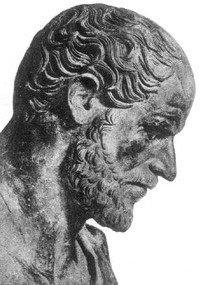
[Plato, Meno]
[96c]
SocratesAnd if there are no teachers, there can be no disciples either?
MenoI think that statement is true.
SocratesAnd we have admitted that a thing of which there are neither teachers nor disciples cannot be taught?
MenoWe have.
SocratesSo nowhere are any teachers of virtue to be found?
MenoThat is so.
SocratesAnd if no teachers, then no disciples?
MenoSo it appears.
SocratesHence virtue cannot be taught?
[96d]
MenoIt seems likely, if our investigation is correct. And that makes me wonder, I must say, Socrates, whether perhaps there are no good men at all, or by what possible sort of process good people can come to exist?
SocratesI fear, Meno, you and I are but poor creatures, and Gorgias has been as faulty an educator of you as Prodicus of me. So our first duty is to look to ourselves, and try to find somebody who will have some means or other of making us better. [96e] I say this with special reference to our recent inquiry, in which I see that we absurdly failed to note that it is not only through the guidance of knowledge that human conduct is right and good; and it is probably owing to this that we fail to perceive by what means good men can be produced.
MenoTo what are you alluding, Socrates?
SocratesI mean that good men must be useful: we were right, were we not, in admitting that [97a] this must needs be so?
MenoYes.
SocratesAnd in thinking that they will be useful if they give us right guidance in conduct: here also, I suppose, our admission was correct?
MenoYes.
SocratesBut our assertion that it is impossible to give right guidance unless one has knowledge looks very like a mistake.
MenoWhat do you mean by that?
SocratesI will tell you. If a man knew the way to Larisa, or any other place you please, and walked there and led others, would he not give right and good guidance?
MenoCertainly.
[97b]
SocratesWell, and a person who had a right opinion as to which was the way, but had never been there and did not really know, might give right guidance, might he not?
MenoCertainly.
SocratesAnd so long, I presume, as he has right opinion about that which the other man really knows, he will be just as good a guide--if he thinks the truth instead of knowing it--as the man who has the knowledge.
MenoJust as good.
SocratesHence true opinion is as good a guide to rightness of action as knowledge; and this is a point we omitted just now in our consideration of the nature of virtue, [97c] when we stated that knowledge is the only guide of right action; whereas we find there is also true opinion.
Meno
So it seems.
SocratesThen right opinion is just as useful as knowledge.
MenoWith this difference, Socrates, that he who has knowledge will always hit on the right way, whereas he who has right opinion will sometimes do so, but sometimes not.
SocratesHow do you mean? Will not he who always has right opinion be always right, so long as he opines rightly?
MenoIt appears to me that he must; and therefore I wonder, Socrates, [97d] this being the case, that knowledge should ever be more prized than right opinion, and why they should be two distinct and separate things.
Socrates
Well, do you know why it is that you wonder, or shall I tell you?
MenoPlease tell me.
SocratesIt is because you have not observed with attention the images of Daedalus. But perhaps there are none in your country.
MenoWhat is the point of your remark?
SocratesThat if they are not fastened up they play truant and run away; but, if fastened, they stay where they are.
[97e]
Meno
Well, what of that?
SocratesTo possess one of his works which is let loose does not count for much in value; it will not stay with you any more than a runaway slave: but when fastened up it is worth a great deal, for his productions are very fine things And to what am I referring in all this? To true opinion. For these, so long as they stay with us, are a fine possession, [98a] and effect all that is good; but they do not care to stay for long, and run away out of the human soul, and thus are of no great value until one makes them fast with causal reasoning. And this process, friend Meno, is recollection, as in our previous talk we have agreed. But when once they are fastened, in the first place they turn into knowledge, and in the second, are abiding. And this is why knowledge is more prized than right opinion: the one transcends the other by its trammels.
Meno
Upon my word, Socrates, it seems to be very much as you say.
[98b] Socrates
And indeed I too speak as one who does not know but only conjectures: yet that there is a difference between right opinion and knowledge is not at all a conjecture with me but something I would particularly assert that I knew: there are not many things of which I would say that, but this one, at any rate, I will include among those that I know.
MenoYes, and you are right, Socrates, in so saying.
SocratesWell, then, am I not right also in saying that true opinion leading the way renders the effect of each action as good as knowledge does?
MenoThere again, Socrates, I think you speak the truth.
[98c]
Socrates
So that right opinion will be no whit inferior to knowledge in worth or usefulness as regards our actions, nor will the man who has right opinion be inferior to him who has knowledge.
MenoThat is so.
SocratesAnd you know that the good man has been admitted by us to be useful.
MenoYes.
SocratesSince then it is not only because of knowledge that men will be good and useful to their country, where such men are to be found, but also on account of right opinion; and since neither of these two things--knowledge 98d] and true opinion--is a natural property of mankind, being acquired--or do you think that either of them is natural?
Meno
Not I.
SocratesThen if they are not natural, good people cannot be good by nature either.
MenoOf course not.
SocratesAnd since they are not an effect of nature, we next considered whether virtue can be taught.
MenoYes.
SocratesAnd we thought it teachable if virtue is wisdom?
MenoYes.
SocratesAnd if teachable, it must be wisdom?
MenoCertainly.
SocratesAnd if there were teachers, it could be taught, [98e] but if there were none, it could not?
Meno
Quite so.
SocratesBut surely we acknowledged that it had no teachers?
MenoThat is true.
SocratesThen we acknowledged it neither was taught nor was wisdom?
MenoCertainly.
SocratesBut yet we admitted it was a good?
MenoYes.
SocratesAnd that which guides rightly is useful and good?
MenoCertainly.
SocratesAnd that there are only two things--[99a] true opinion and knowledge--that guide rightly and a man guides rightly if he have these; for things that come about by chance do not occur through human guidance; but where a man is a guide to what is right we find these two things--true opinion and knowledge.
MenoI agree.
SocratesWell now, since virtue is not taught, we no longer take it to be knowledge?
MenoApparently not.
[99b]
SocratesSo of two good and useful things one has been rejected: knowledge cannot be our guide in political conduct.
MenoI think not.
SocratesTherefore it was not by any wisdom, nor because they were wise, that the sort of men we spoke of controlled their states--Themistocles and the rest of them, to whom our friend Anytus was referring a moment ago. For this reason it was that they were unable to make others like unto themselves--because their qualities were not an effect of knowledge.
MenoThe case is probably as you say, Socrates.
SocratesAnd if not by knowledge, as the only alternative it must have been by good opinion. [99c] This is the means which statesmen employ for their direction of states, and they have nothing more to do with wisdom than soothsayers and diviners; for these people utter many a true thing when inspired, but have no knowledge of anything they say.
Meno
I daresay that is so.
SocratesAnd may we, Meno, rightly call those men divine who, having no understanding, yet succeed in many a great deed and word?
MenoCertainly.
SocratesThen we shall be right in calling those divine of whom [99d] we spoke just now as soothsayers and prophets and all of the poetic turn; and especially we can say of the statesmen that they are divine and enraptured, as being inspired and possessed of God when they succeed in speaking many great things, while knowing nought of what they say.
Meno
Certainly.
SocratesAnd the women too, I presume, Meno, call good men divine; and the Spartans, when they eulogize a good man, say--“He is a divine person.”
[99e]
MenoAnd to all appearance, Socrates, they are right; though perhaps our friend Anytus may be annoyed at your statement.
Socrates
For my part, I care not. As for him, Meno, we will converse with him some other time. At the moment, if through all this discussion our queries and statements have been correct, virtue is found to be neither natural nor taught, but is imparted to us by a divine dispensation without understanding in those who receive it, [100a] unless there should be somebody among the statesmen capable of making a statesman of another. And if there should be any such, he might fairly be said to be among the living what Homer says Teiresias was among the dead--“He alone has comprehension; the rest are flitting shades.” In the same way he on earth, in respect of virtue, will be a real substance among shadows.Meno, by Plato:http://www.gutenberg.org/etext/1643Apology, by Xenophon:http://www.gutenberg.org/dirs/etext98/aplgy10.txtThe Trial and Death of Socrates:
http://www.age-of-the-sage.org/greek/philosopher/trial_death_socrates.html
Socrates sought a singular virtue for human life.
Plato identified four central virtues present in the ideal state or person.
Aristotle holds that every moral virtue is the mean between vicious extremes.
"Crito, we owe a cock to Asclepius. Do pay it. Don't forget."


 ə
ə